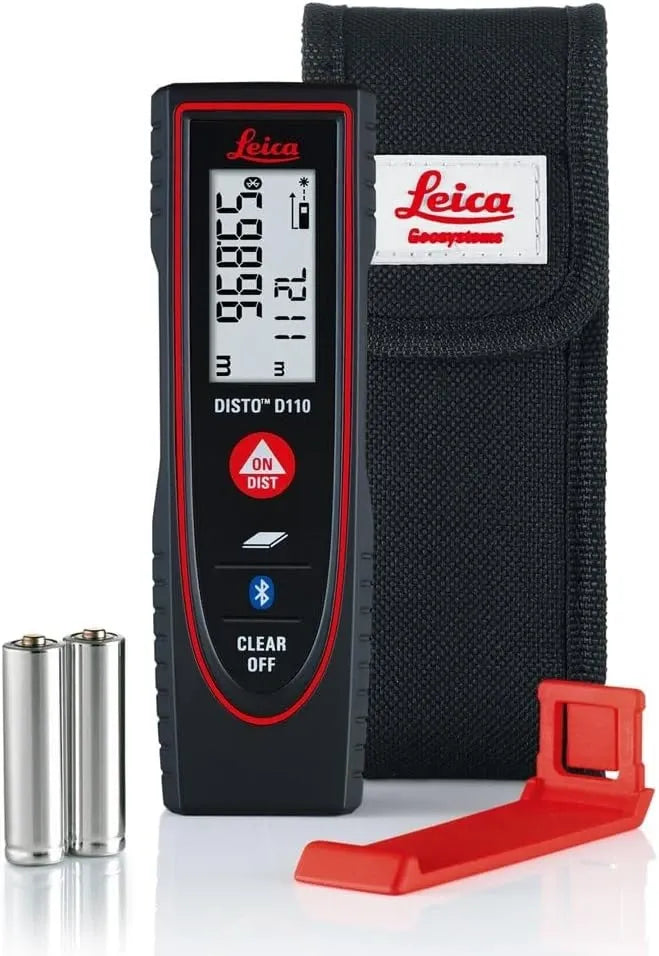
When outdoor distance readings fail
Target finish, daylight and aiming can matter more than the distance printed on the box.
Treat maximum range as a conditional specification, not a promise for every surface.
One useful observation, one clear limit
In its historic Huepar distance-measure review, Laser Level Review reported a successful 63.8 m reading from a white car and no reading from the brickwork behind it. The sample actually tested was an LM90C, even though the article title also names the LM200.
We read that page on 21 September 2026. It is a specific author observation, not proof of accuracy across the full range, and it cannot be applied to the LM200 as if that model were tested. We have not repeated the experiment.
Help the instrument see the target
A stable, well-defined target makes a reading easier to interpret. Strong daylight, a dark or shiny surface, an angled target and a moving hand can all affect whether the intended point returns a usable signal. Follow the manual for suitable targets and operating conditions.
A digital viewfinder can help you aim when the dot is difficult to locate; it does not by itself guarantee a successful or accurate measurement. Likewise, a target plate is not a universal extension of the rated range.
Compare conditions, not anecdotes
Use the same distance, starting point and support when comparing a white target, brick and a dark surface. Record time, weather, surface, battery state, selected reference and the number of attempts. Count failed readings as a result rather than silently discarding them.
Separate the success rate from the error of successful readings. A device that returns a number every time still needs comparison with a suitable reference. A device that fails at one target has not necessarily failed at every outdoor task.
- Start with a distance available safely on your own site.
- Record aiming time as well as the reading.
- Use a controlled target position rather than a moving vehicle.
- Do not extend a short-distance check into a 100 m claim.
Keep measuring and setting out distinct
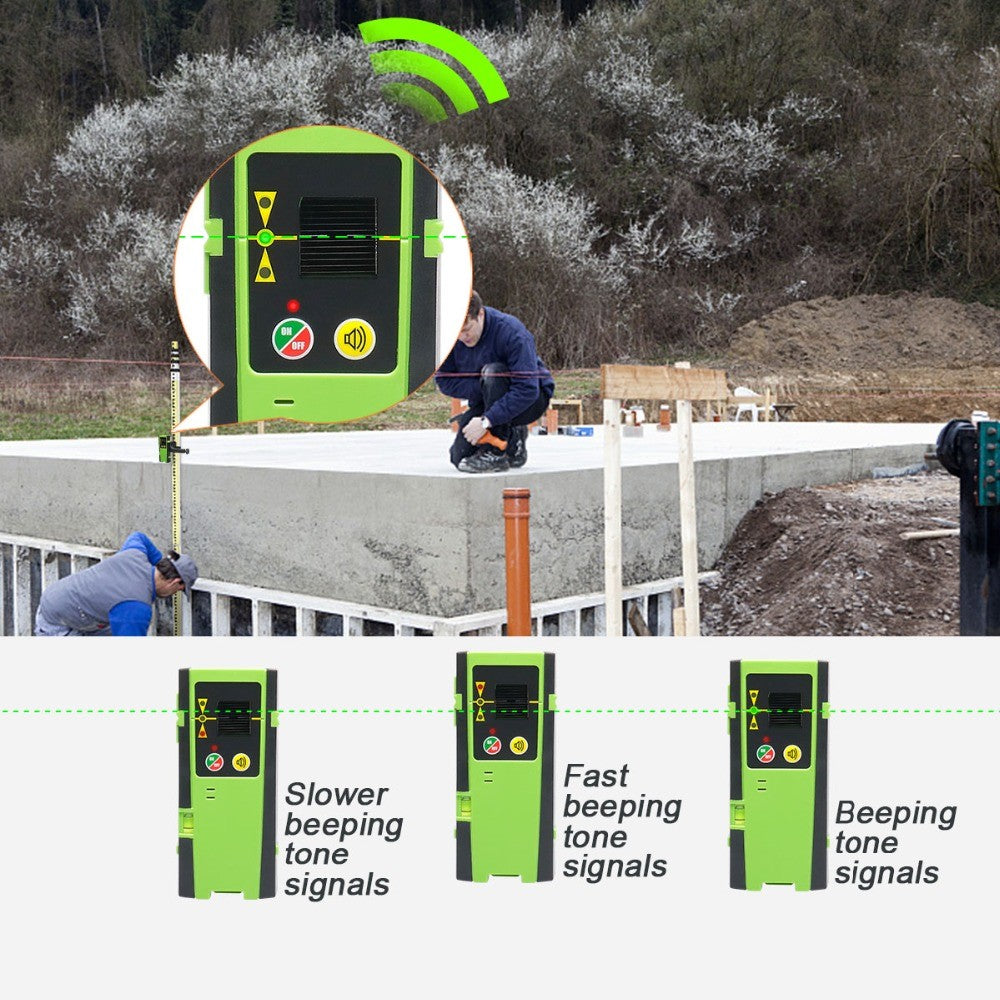
A receiver for a line or rotary laser is not a general accessory for extending a handheld laser measure. It detects a compatible setting-out beam. Choose the tool by the task: a distance between points, or a height/reference line across a site.
For longer baselines and work with a demanding tolerance, check the instrument specification and the reference method before relying on the result.
Sources & evidence
Source observations: 21 September 2026. These references describe the named devices and conditions; they do not establish current UK availability or universal compatibility.
Laser Level Review: Huepar T7-LM90 / LM200Read on 21 September 2026. The tested sample was an LM90C. Historic observations, not a current UK product recommendation.Laser Level Review: Leica DISTO X3 and X4Read on 21 September 2026. Published in 2018. Early app and firmware observations should not be treated as current behaviour.